

Huanchaco: An Ancient Fishing Village
Huanchaco is located 14 km northwest of the city of Trujillo. This ancient fishing village has preserved the ancestral tradition of using caballitos de totora (traditional reed boats), which were used by the Moche and Chimú civilizations. These fishing boats were so important that they were depicted on Moche pottery and in the murals of Chan Chan.
Huanchaco was already a fishing village before the arrival of the Spanish. During the government of Viceroy Francisco de Toledo (1569–1581), part of the population of Mansiche was relocated to this town.
The Origin of the Name Huanchaco
The name Huanchaco has been in use since at least the 18th century. Several theories exist regarding its origin.
One possibility is that the name comes from Huaycocha or Wuacocha, which may have meant “fish lagoon.” This interpretation is associated with the semicircular shape of the beach.
Another version suggests that, in the past, fishermen painted their chests red before going out to sea, imitating the color of a bird known as the Huanchaco. They were consequently called huanchaqueros, while the place where they lived was known as Huaycocha.
A third theory links the name to the cultivation of totora reeds. Since Moche times, farmers had cultivated these reeds in areas known as huachaques. In the Muchik language, this word means “sunken field” and refers to cultivated plots supplied by underground water. Because of the phonetic similarity, it is possible that the name Huanchaco derives from this term.
Huanchaco During the Colonial Period
During colonial times, Huanchaco served as an important port. However, it gradually lost its commercial importance around 1870, when the Port of Salaverry was established. In 1891, a 108-meter-long pier was built in Huanchaco, and it has been preserved to this day.
The Church of Our Lady of Candelaria
From the beach, visitors can see a church standing on top of a hill. Dedicated to Our Lady of Candelaria, it was built on the site of a former Chimú temple.
Inside the church is an image of the Virgin of Candelaria, reportedly donated by King Charles V. The sculpture was made in Seville and is said to have been modeled on the face of the king’s mother, Joanna of Castile, also known as Joanna the Mad.
According to local tradition, the image arrived in Huanchaco on February 2, 1537. It is regarded as one of the oldest Marian images in Latin America.
Since 1861, every five years, the image has been taken from Huanchaco to the city of Trujillo. The Chapel of San José, located in Chan Chan, was built as a resting place for the procession during this journey.
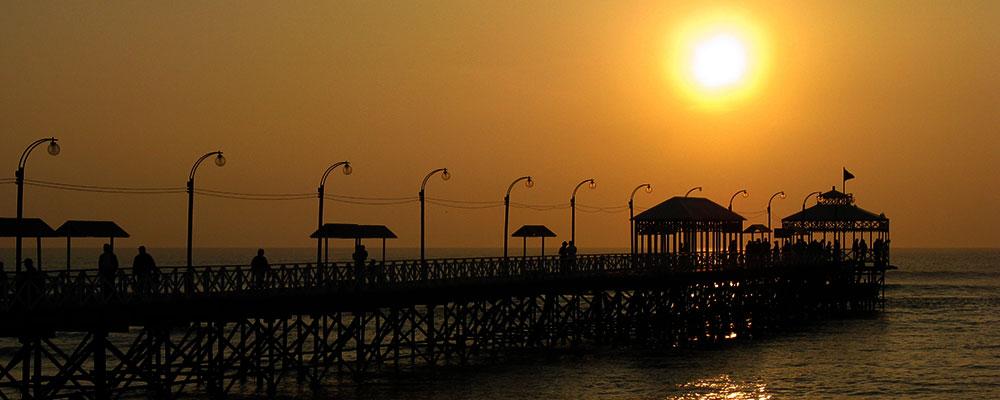
Today, Huanchaco is the most popular beach destination in the Trujillo area. It is also an excellent place for surfing enthusiasts. For seafood lovers, it is an ideal destination, as the restaurants along the seafront offer delicious local dishes prepared with fresh fish and seafood.
The charming hotels welcome visitors who wish to spend a night enjoying the sound of the waves and the gentle sea breeze. There are countless reasons to visit Huanchaco and hardly any excuses not to experience this beautiful coastal town at least once in your lifetime.