
Huaca Cao Viejo is located approximately 60 km north of Trujillo, in the Chicama Valley, near Magdalena de Cao, overlooking the Pacific Ocean. Together with Huaca Cortada and Huaca Prieta, it forms part of the El Brujo Archaeological Complex.
Archaeological research at the site began in 1990, sponsored by Banco Wiese.
Huaca Cao Viejo was built by the Moche civilization around the 1st century AD and was abandoned around 600 AD, possibly following the devastating effects of an El Niño phenomenon.
Architecture
Its architecture is similar to that of Huaca de la Luna. The temple consists of seven superimposed construction phases, resulting from the ancient Moche practice of burying older structures and building new temples on top of them. This practice may have been associated with important events or changes in the ceremonial life of the community, although its exact reasons remain uncertain.
During its final occupation, the temple reached approximately 30 meters in height, with a base measuring 120 meters on each side.
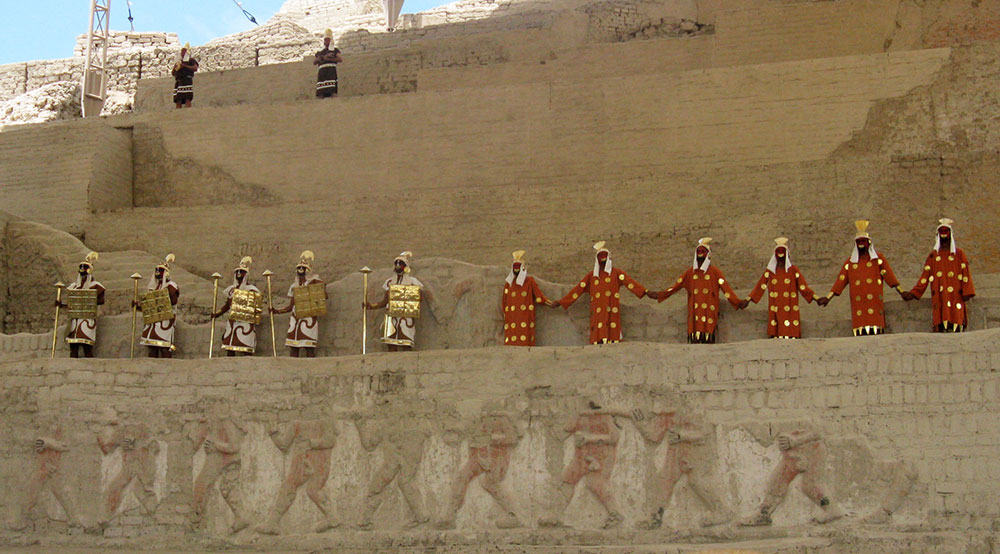
In front of the temple stands a large ceremonial plaza, measuring approximately 140 by 75 meters and oriented toward the north. From this plaza, visitors can admire the temple façade, where archaeologists discovered some of the most remarkable examples of Moche polychrome relief decoration.
The colorful reliefs depict different scenes and figures, including naked prisoners with ropes around their necks, dancers, warriors and the Decapitator deity holding a human head.
Inside the temple, archaeological excavations have uncovered ceremonial courtyards with exceptionally well-preserved original colors, providing valuable insight into Moche religious practices and artistic traditions.
Important Burials
As at Huaca de la Luna, important individuals were buried within the successive construction phases of the temple. Archaeologists discovered the tomb of a high-ranking individual accompanied by 15 people, including 11 women. Unfortunately, the tomb had been looted, and the human remains and principal funerary offerings were no longer present.
Following the decline of the Moche civilization, the temple continued to serve ceremonial purposes. During the Lambayeque period, the main plaza was used as a burial ground. Several mummies from this period have been discovered, buried in a fetal position.
By the time the Spanish arrived, the area was home to a considerable population. Dominican priests subsequently built a Catholic church over the ancient ceremonial plaza. Remains of this colonial structure can still be seen at the archaeological site.
The Lady of Cao: A Remarkable Moche Discovery
One of the most important archaeological discoveries in Peru was the tomb of the Lady of Cao, a high-ranking woman who is believed to have held considerable political and religious authority in Moche society in the Chicama Valley.
She lived during approximately the same period as the famous Lord of Sipán, although they belonged to different regions of the Moche cultural world.
The extraordinary aspect of this discovery was the remarkable preservation of her body, including her skin. Her arms and other parts of her body were decorated with elaborate tattoos depicting snakes, spiders and other symbolic designs.
These tattoos, together with her funerary ornaments and burial offerings, provide important evidence of her high social status and the role of women in ancient Moche society.
Today, the mummy of the Lady of Cao and many of the ornaments discovered in her tomb are exhibited at the Cao Site Museum, located within the El Brujo Archaeological Complex.
The discovery of the Lady of Cao changed our understanding of the Moche civilization and remains one of the most fascinating archaeological findings on the northern coast of Peru.

HUACA PARTIDA O CORTADA
Its located in front to Huaca Cao, this construction is much smaller and is not excavated. However, is possible to suposse that had an administrative function during the Moche times. Some designes of fishes were discovered but now is all covered.
HUACA PRIETA
This site was studied by Junius Bird in 1946, who discovered here the first scientific evidences of Pre-ceramic people. Before that, Chavin culture was considered the oldest culture in Peru. However, Huaca Prieta is older, 2 500 B.C. These people were fishermen and hunters with simple agriculture.